"Cats are independent, I'll leave food and water and she'll be fine for the long weekend." The first half is true. The second is why, every Clean Monday and every 15th of August, some people come back to an empty water bowl, or to a cat that needs a vet urgently.
The short answer
A healthy adult cat is fine alone for a working day or for one night. The British charity Cats Protection puts the limit at around 12 hours, and for kittens at just a few hours at a time.
Beyond one night, someone needs to come by at least once a day.
Why a full bowl isn't enough
Food is the easy part. What goes wrong in an empty home is usually something else:
- Water. A bowl tips over with one paw. In August, in a closed Athens flat, that becomes a problem within a day.
- The automatic feeder. It jams, the batteries run out, or the cat learns to empty it. It helps, but it doesn't replace a person checking that it worked.
- The litter. Many cats refuse a dirty tray and find somewhere else, or hold on.
- Closed doors. A cat shut by accident in a wardrobe or room has neither water nor litter.
- Health. A cat that has stopped eating, or keeps going to the tray without passing urine, needs a vet the same day. In male cats a urinary blockage is an emergency. Nobody will see it if nobody visits.
- Heat. In summer a flat with closed windows gets very hot. Someone has to be able to air it and set the shutters properly.
Cats that need more
Some cats shouldn't be left alone even for a whole day:
- kittens under about six months,
- elderly cats,
- cats on medication or a special diet at set times, such as diabetic cats,
- cats that have just arrived in the home or just had surgery.
For these, two visits a day is the sensible minimum.
Why not take her somewhere else
Cats are attached to their territory more than to their routine. The carrier, the car and an unfamiliar home full of strange smells are, for most of them, far more stressful than your absence. That is why the answer that nearly always fits is for the cat to stay where she is and for someone to come to her. More in cat sitting in Athens.
What happens during a visit
A proper visit isn't two minutes to top up the bowl:
- fresh food and water, bowls washed,
- litter cleaned,
- some play or company, as much as the cat herself wants,
- a check that she has eaten, used the tray, and is moving and behaving normally,
- a look around the home: windows, balcony doors, room doors.
On Petit-o this service is called feeding or a home visit, and most sitters ask €6–12 per visit (November 2026). The full breakdown is in the price guide.
Before you leave
- Close windows and balcony doors properly. Open upper-floor windows and tilt-opening windows are among the most common causes of accidents.
- Leave two bowls of water in different places.
- Leave internal doors open, or wedge them so they can't shut.
- Write down where the cat usually hides. A sitter who can't see her needs to know where to look before worrying.
- Leave the vet's phone number and the health booklet.
The full list is in what to leave with the sitter.
How to book it
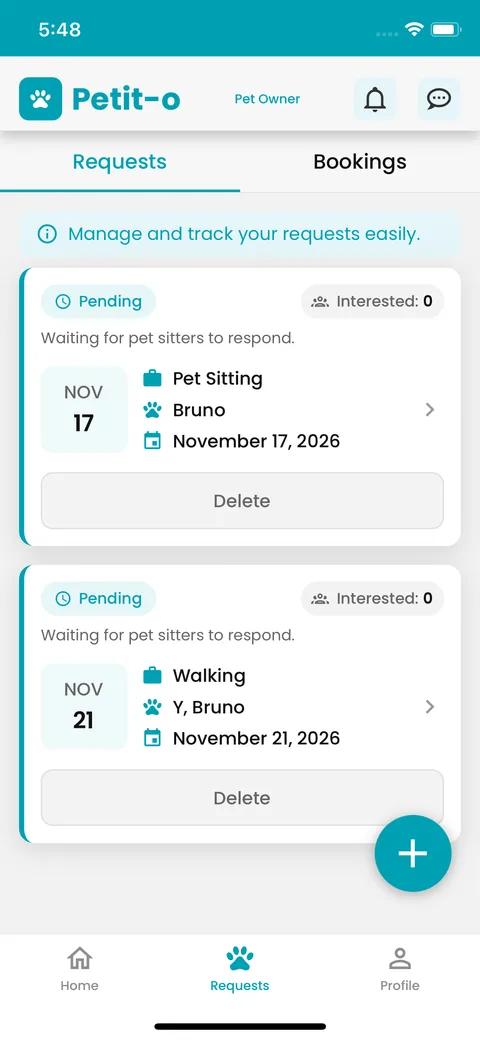
You send a feeding request with the dates and times you want. You see which sitters are interested, read profiles and reviews, and write to them first to ask whatever you like, for example whether they have looked after a shy cat before. The sitter sees your area, not your exact address, until the booking is made.
Over the holidays and in August many people are looking for the same days, and availability depends on how many sitters are near you. If you already know when you are leaving, see where to leave your pet during the holidays and send the request early.
Eleni truly loves animals! She didn't just feed my little one: she changed the litter, played with him, emptied the water fountain (washed it and refilled it with fresh cold water)… and sent me videos and photos of my baby.